
Keeping alive endangered crafts
An interview with Alexandra and Jessamijn, May 2026
In February 2026, the seventh edition of the Endangered Craft Mugaam (camp) once again brought the community together during Auroville’s birthday week for an event that has quietly become a cherished tradition. Popularly known as ECM, the week-long gathering celebrates crafts that are increasingly disappearing in the face of changing economies. Unlike conventional craft fairs that focus mainly on display and sale, ECM centres on learning. Children from Auroville and the bioregion spend an entire week immersed in making — learning a wide variety of skills and crafts by working directly with artisans from Tamil Nadu and elsewhere in India.
The mugaam (or camp) brings together children, craftspeople, volunteer organisers and supporters in a lively shared space. Beyond preserving endangered crafts, the event creates a real opportunity for children to experience concentration, collaboration and the joy of making something with their own hands. We spoke to two of the organisers, Alexandra and Jessamijn, about ECM, its origins and why making things matters.
How would you introduce yourselves for our readers?
Alexandra: My name is Alex and I live in Fertile (an Auroville settlement). I volunteer at the Botanical Gardens and with the Endangered Craft Mugaam. I’ve been in Auroville for nine years now.
I arrived around 2017 after a friend recommended Auroville. At that time I was living in Luxembourg and wanted to begin a new life somewhere else. I arrived here curious to experience and understand the “community life” in Auroville that my friend was always talking about. I came here intending to stay for only a couple of months but I think it takes a really long time to understand Auroville, so I’m still here — trying to understand it!
Jessamijn: I live in Udumbu (another Auroville settlement). We first came to Auroville because we had friends here, so for many years we were visiting and trying to imagine ourselves living here.
In terms of community life, it felt very easy and beautiful. But in terms of work, I found it difficult to imagine what I would do here until we met someone working with the Auroville Village Action Group. Suddenly I could imagine myself here in terms of work too in the bioregion, and I felt very attracted to that vision.
So, we moved here in 2010.
For most of this time, we’ve been caretaking and looking after the forest.
And how did you become involved with the Craft Mugaam?
We were part of a school called TLC – The Learning Community, where parents also participate actively. Through that community, we often visited Marudam (an alternative school in Tiruvannamalai), where they organise a craft week. The TLC children would participate there, visit artisans, and learn.
Johnny [an Auroville pioneer] was always saying we should have a craft week in Auroville. Then, around Auroville’s 50th birthday celebrations, Marc [an Auroville resident and designer] wrote a proposal for a craft week.
We learned a lot from what Marudam had already been doing. We also brought in the same craftspeople, who had experience working with children, so in some ways it gave us an easier beginning.
That’s how it all started.
Do you coordinate with Marudam in terms of timing?
No. Their event happens in November. We hold ours during Auroville’s birthday week because most Auroville schools are free then.
What have your roles been within the Craft Mugaam?
Our roles keep changing from year to year, which is actually very nice. We have a core team, including a lot of Fertile residents, and many of us have known each other for a long time.
Usually, craft melas are simply exhibitions. What made you feel children should actually learn the crafts hands-on?
That’s exactly what blew me away when I first experienced the craft week at Marudam.
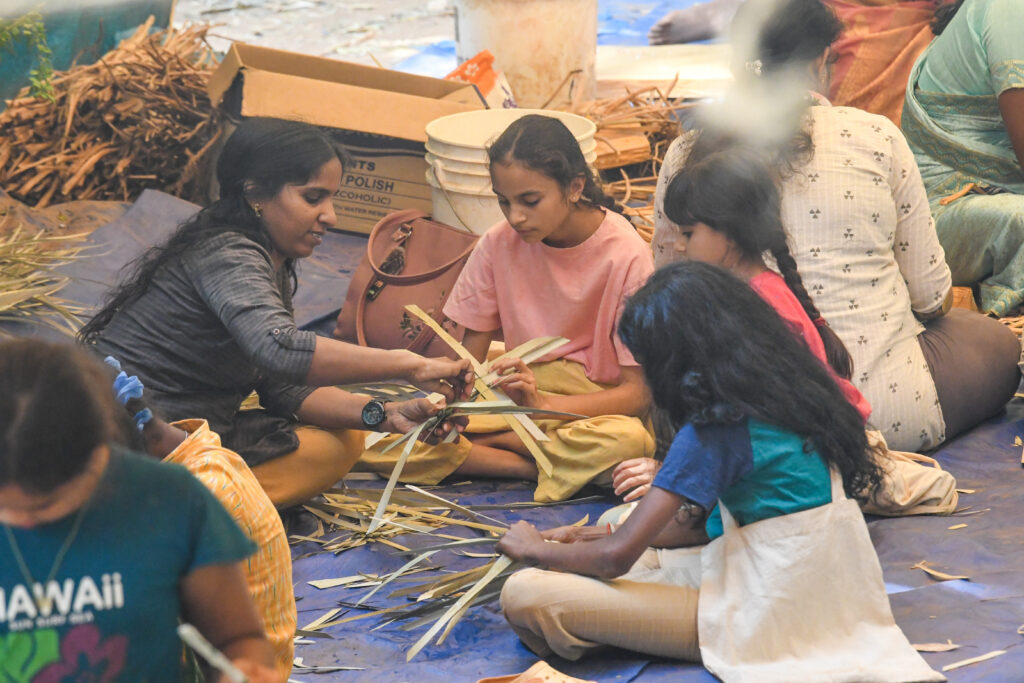
In school, children might get one or two hours of craft activities — and then that’s it. But here, they spend full days immersed in making things. They have access to materials, tools, and craftspeople who can guide them continuously over several days.
Concentrating deeply and finishing something with your own hands is a completely different experience. They understand the effort that goes into creating something. It enables them to appreciate the value of handmade work better.
It is also incredibly empowering.
Johnny, who has been a driving force behind ECM, has always encouraged children to make things. One of his biggest passions is helping children feel agency — helping them realise anything you can imagine, you can make.
Many children don’t get this kind of exposure at all. And spending a whole week immersed in craft can shift something deeply inside them. I think it helps them stand in the world with more confidence.
How do children respond to it? With attention spans becoming shorter these days, do they stay engaged?
We might have to ask the craftspeople if they perceive any change.
From our experience, the children are incredibly excited. Every morning we gather for assembly, and afterwards they can hardly wait to run to the craftspeople.
I am amazed by how concentrated the children are. Even children who normally use phones are completely absorbed in the work. There is very little distraction.
I think a lot of distraction comes from boredom. When something meaningful is offered, children naturally place their attention there instead.
Over a full week with around 175–200 children, there are surprisingly few accidents or conflicts, even though they’re using real tools.
That always amazes me.
Johnny has spoken about the separation between “makers” and “thinkers”, and how making itself can become an act of resistance.
Yes, absolutely.
When children begin making things themselves, not only do they develop a sense of agency but also, they understand the labour, skill, and intelligence involved. There’s often disregard for artisans and handmade work because people don’t understand what goes into it. But when an artisan becomes your teacher, something shifts. The relationship becomes human, soft, respectful.
That appreciation for craft and for the artisan is very important.
What goes into organising ECM?
The Auroville schools have holidays because it’s Auroville’s birthday week, and many children choose to come, even during their holidays.
The Auroville outreach schools don’t have holidays, and they too are very keen to participate. Most try to send an entire class.
Unfortunately, we usually have to limit numbers because we can’t host 300 children.
The scale of the event is impressive — the food, accommodation, organisation. How does all that work?
We have around 28 volunteers and apprentices, and the core team itself is around 15–20 people.
We have a diverse set of volunteers – doers, thinkers, dreamers – and it gives the ECM a distinct flavour.
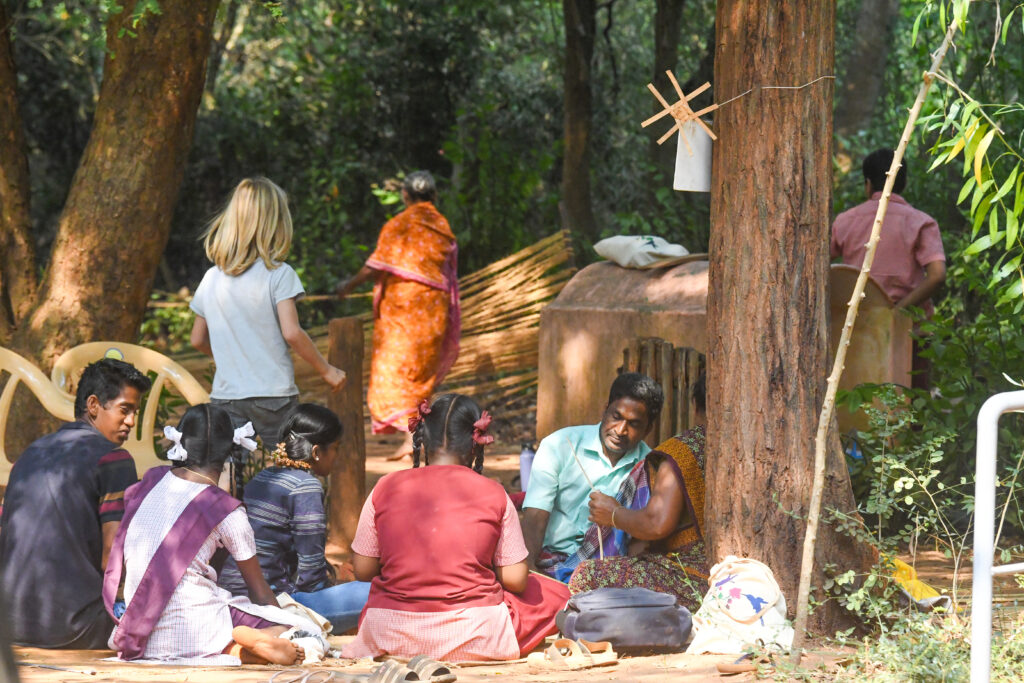
We also work with about 50 craftspeople. Of these, 35 are from outside Auroville. Some are from nearby villages, while others are from outside Tamil Nadu. We also have Auroville craftspeople involved — people doing upcycling, woodworking, and other crafts.
Around 180 children participate from Auroville outreach schools and other schools in the region. One of our craftspeople brings school children from Gujarat.
The food is extremely important because it keeps everyone together. Children don’t leave the space, so the atmosphere and concentration continue throughout the day.
There’s a cooking team, and over the years we’ve become more experienced about what is needed.
We borrow many things from different places — kitchen equipment, bedding, materials — and over time people have also donated items to us.
Because we’re such a large group, the work feels manageable.
How has the event evolved over the years?
Organisationally, it has definitely become easier because we now understand how the week functions.
The space itself has changed because we clean it up.
We’ve also spent a lot of time building relationships with craftspeople.
Every year we introduce themes. One year it was nature, another year insects, then mushrooms, and this year it was birds.
The themes help each craftsperson to interpret and express the subject through their own medium.
For example, this year the woodworkers made birds, stencil artists created bird stencils, and Kalamkari artists incorporated birds into their work.
We also try introducing a new craft each year. This year it was hyacinth-based craft.
What have been some of the biggest challenges?
One challenge is increasing formalisation.
Originally this was a very light, volunteer-driven activity. Many people contribute in kind — food items, materials, wood, wax, snacks, and other supplies. Some craftspeople even offer their workshops without expecting payment.
That spirit of collective contribution is one of the most beautiful aspects of the event. It brings together people who normally don’t meet.
Now, even though the nature of the work hasn’t changed, the bureaucracy around it has increased. We are now required to function more like an official unit, with accounting responsibilities and administrative requirements.
Another major challenge is funding. Every year we have to raise money again because the project does not generate profit. We have been funded by the Foundation for World Education, Stichting De Zaaier, HiDesign, and AVI – USA.
We’ve been fortunate to receive support from several individual donors even though that doesn’t cover the costs.
Do you think something like this is only possible in a place like Auroville?
I think it’s possible elsewhere too, but outside Auroville it would probably require a larger budget because so much of what happens here is volunteer-driven.
Many of us do this work for free, out of passion.
That creates a very particular energy.
You also invite performing artists every year.
Yes. We always try to include evening performances as a way for the community that has anyway gathered at one place to celebrate something.
We focus especially on traditional performing arts because many of those traditions are also endangered.
This year we had musicians from Chennai performing songs inspired by the landscapes described in ancient Tamil literature.
They explained the emotional qualities associated with each landscape — longing, thirst, joy — and then sang compositions based on them.
One musician had even recreated ancient instruments based on museum references.
It was extraordinary. It was good too for Aurovillians to get an exposure to the local alternative movements (these musicians belong to).
Any memorable anecdotes?
Jessamijn: One thing that deeply moved me was a girl from Deepam (Auroville school for children with special needs) who returned to teach crochet during the craft week. When her father came and saw her teaching, he became very emotional and said how proud he was.
That moment stayed with me.
Another thing I’ve noticed personally is that through the craft week, I myself began working more with my hands. In offering these experiences to children, we also rediscover them for ourselves.
Over the years we’ve built beautiful relationships with the craftspeople.
Alexandra: I love seeing the pride children feel in the things they create. Their feedback every year is incredibly enthusiastic.
How do the artisans themselves experience the week?
Many of them genuinely want to return every year.
The space is simple and makeshift, but there’s warmth and affection. Some artisans have expressed that despite difficult personal circumstances, they have come because they value the experience so much.
For many women especially, this may be one of the few times they spend away from home in a shared creative environment. One of the women involved with water hyacinth crafts told us she loved being here because she didn’t need to cook or clean — she could simply enjoy the experience.
The craftspeople also build strong relationships with each other over the years. Many of the women stay together in shared rooms, and they’ve become very comfortable with one another.
There’s joy, community, music, dancing, and friendship.
It’s beautiful to witness.
What plans do you have for the future?
Right now, we mostly take it one year at a time because funding is always uncertain. But there have been discussions about offering more activities throughout the year.
Marc, Johnny, and others already run Saturday sessions in Fertile through the Low-tech Lab, where children engage in woodworking and upcycling.
There’s interest in extending such initiatives further.
This year it was called “Craft Mugaam” whereas earlier it was called a mela.
Yes. We now use the Tamil word mugaam to make it feel more local.
Mela et mugaam both carry the sense of gathering together, but mugaam felt closer to the spirit of what we’re doing.
Any concluding thoughts?
One thing I really hope is that this inspires other communities. We were inspired by Marudam, and now others are becoming inspired by us.
This year someone visited and began thinking about how they might organise something similar in their own community.
What makes this work is the spirit behind it — people doing things voluntarily, with care, passion, and love.
If everything becomes too formalised and administrative, it risks losing that spirit. Financial compensation, even though necessary, should not be the sole factor driving the event.
The energy comes from people genuinely wanting to create something together. That’s what makes it alive.

In conversation with Mari, May 2026
The short-form of this article was first published in Voices of Auroville, Issue 11